
Finding Tulsa County Residents by Record Type
A Tulsa County residents directory is a set of separate records, not one complete roll. The Assessor is usually the fastest way to connect an address, account number, subdivision, or owner string to a parcel. The County Clerk then supplies the recorded instrument trail behind that parcel. For an older household, the Tulsa City-County Library directories provide a different kind of evidence: a dated listing of people and addresses rather than a present assessment record. Use the record that fits the question instead of asking one index to prove everything.
An owner name on a property card is not proof that the person lives there, and a directory entry is not proof of legal title. Court results, voter information, and vital indexes also have narrower purposes. The most reliable result comes from two independent records that match on ordinary details such as a name variant, a time period, or an address. That approach helps prevent a same-name result from becoming a false identification.
- Start with Tulsa County Assessor Property Search when an address, parcel account, subdivision, or owner name is known.
- Save the situs address, parcel identifier, and legal description rather than relying on a display name alone.
- Use the County Clerk’s Acclaim legal-description search for the deed, lien, or plat trail that follows that parcel.
- For a past household, request the relevant city-directory year from the Library Research Center or the Genealogy Resource Center.
- When an online record ends, ask the named custodian for a focused inspection, copy, or records-request route.
Tulsa County Offices That Keep Resident Records
County and city boundaries matter in Tulsa County. The Assessor, County Clerk, Treasurer, District Court, and election administration serve county-level work, while a City of Tulsa permit or Municipal Court file follows city jurisdiction. The three offices below form the core trail for property and registration questions. For a block-by-block method, the Tulsa County street directory focuses on address-keyed records without treating a county roll as a household list.
Tulsa County Clerk Land Records
Real Estate Services / Recording
Tulsa County, Oklahoma
918-596-5801, option 3
Oklahoma State Election Board
Statewide registration access
Oklahoma
Use the official portal or records request
Tulsa County Property Search Uses One Field
Assessor Property Search is a practical Tulsa County residents directory starting point because one free-text box accepts an address, account number, subdivision, or owner. The office advises using less text, avoiding punctuation, and narrowing results with column filters. Quotes require an exact phrase, while a minus sign excludes a term. The result is current assessment information, not the legal ownership record, so a transfer or lien needs confirmation through the County Clerk.
| Assessor field or control | How it works |
|---|---|
| Address, account, subdivision, or owner | One required free-text query, including forms such as 123 N Something St or an account identifier. |
| Exact phrase and exclusion | Quoted terms require a match; -term removes a word from results. |
| Column filters | Post-search controls narrow the returned property rows. |
A view of the Assessor search screen shows the address, account, subdivision, and owner prompt used for this first step.
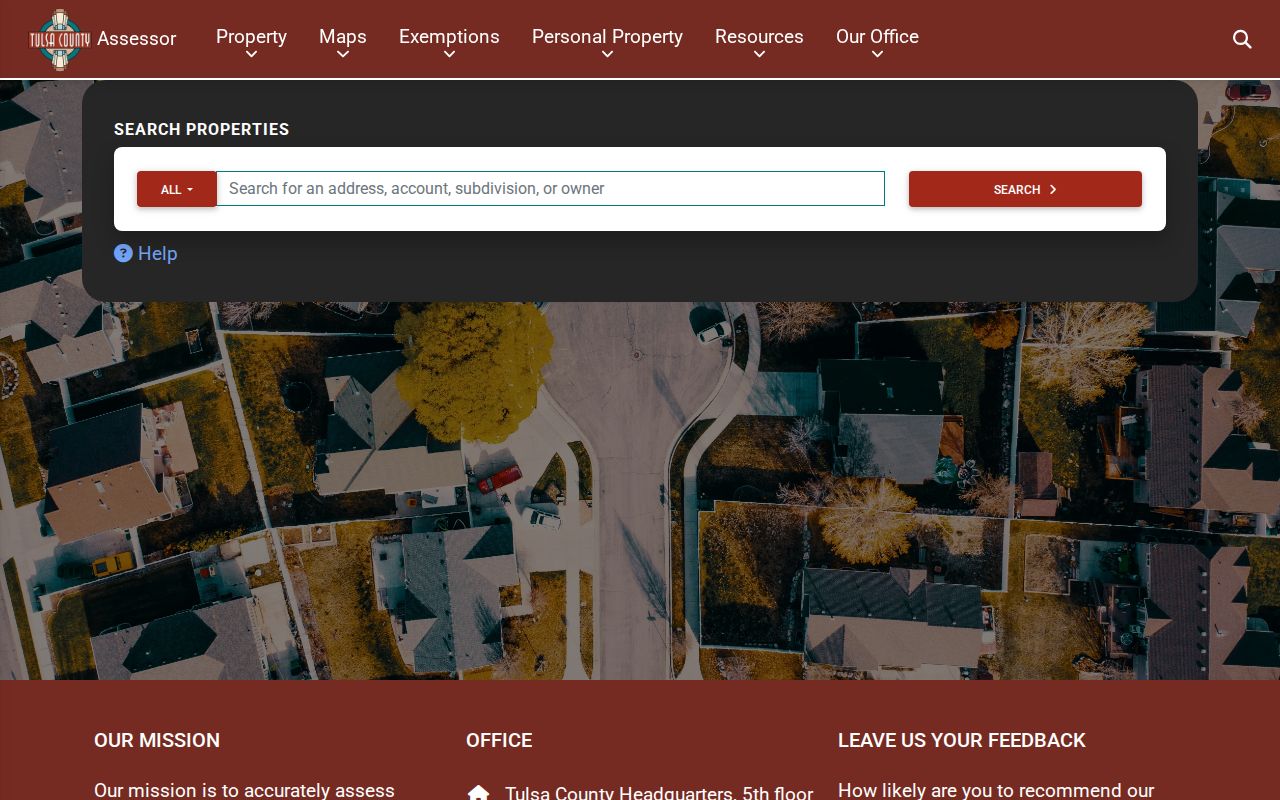
Use the resulting parcel data to choose the next custodian, rather than treating the search screen as a complete roster of residents.
Note: An assessor result can lag a recorded transfer, so compare it with the Clerk’s instrument record before relying on a title conclusion.
Tulsa County Deed Records Start at Different Dates
Tulsa County’s recorded land system has two online starting points. The County Clerk describes name indexing from 1928 to current and legal-description indexing from 1987 to current. Acclaim’s documented parcel mode asks for a legal parcel, then permits a matching option, document type, and date range. It is fee-based and the public web service is account-gated, so the Clerk counter, Historical Camera Record Images, and a focused request remain important routes for earlier work.
The parcel search does not promise a street-address lookup. Begin with the Assessor’s parcel and legal description, then move to Acclaim’s parcel and legal-description route. A result’s “Verified through” notice provides a useful currency check. The recorded grantor and grantee names trace transactions; they do not by themselves identify present occupants.
A County Clerk Acclaim name-search view illustrates the account-gated land-records entry point.
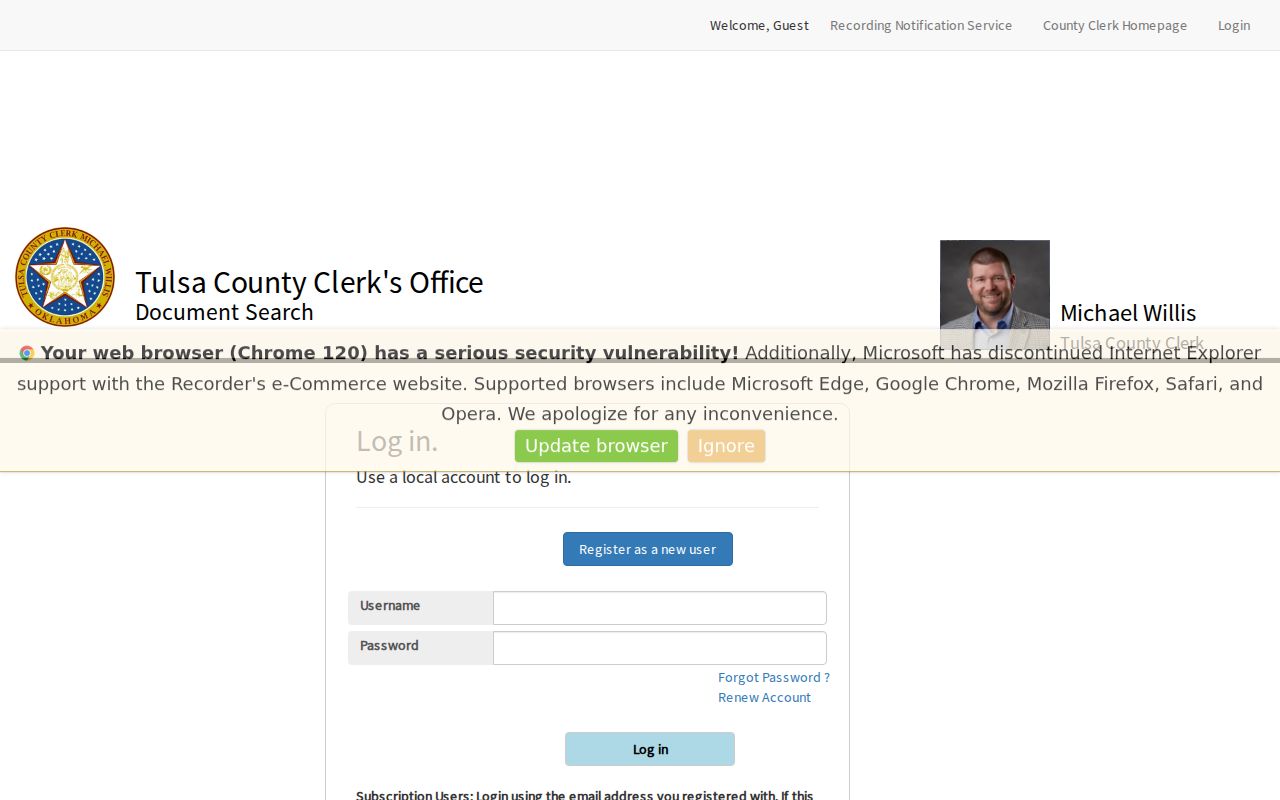
For older instruments, ask the Clerk about the historical camera and book channels instead of assuming a blank web result means no deed exists.
Current Sources in the Tulsa County Residents Directory
Current sources answer different questions. The property roll ties an owner string to a parcel and tax mailing address. The recorded-land index supplies parties to deeds and liens. The voter portal is designed for an individual’s own verification and requires the registered name plus date of birth, while broader voter information follows a separate authorized request channel. These records can corroborate one another, but none is a public browse-by-household directory.
| Source | Who It Lists | Keeper | Access |
|---|---|---|---|
| Assessor property roll | Owners and parcel fields | Tulsa County Assessor | Free public search |
| Voter verification | A registrant’s own status and precinct details | State Election Board | Name plus date of birth |
| Recorded land index | Parties to deeds, mortgages, liens, and plats | Tulsa County Clerk | Registered fee-based service |
| District Court index | Matched parties and case identifiers | OSCN / Court Clerk | Public docket index; protected files excluded |
| Library history collections | Dated city-directory and newspaper clues | Tulsa City-County Library | Digital, appointment, or in-person routes |
Use ownership records for a parcel question, a directory year for a former household, and the court index only to locate a case that must be checked with its custodian. A name-first verification sequence should account for same-name court results before treating a record as a match.
Reading a Tulsa County Parcel Card Carefully
A parcel card commonly displays a situs address, owner name, owner mailing address, parcel ID, land area, school district, legal description, and improvement data. Situs means the land’s location. The mailing field tells the Assessor where tax mail goes, and it may differ from the property location for many ordinary reasons. “Year built” appears in an assessment table organized by tax year, so it is not a recorded deed date or a guaranteed construction-completion date.
- Parcel
- A numbered unit of land used by the assessment system.
- Situs address
- The location of the property, which can be formatted differently from a mailing address.
- Legal description
- The lot, block, subdivision, or survey language that ties land to a recorded instrument.
- Index
- A finding tool that points to a record; it is not necessarily the image or certified copy itself.
A sample public parcel-card view shows the type of fields visible in the assessment system without making any individual record the subject of this directory.
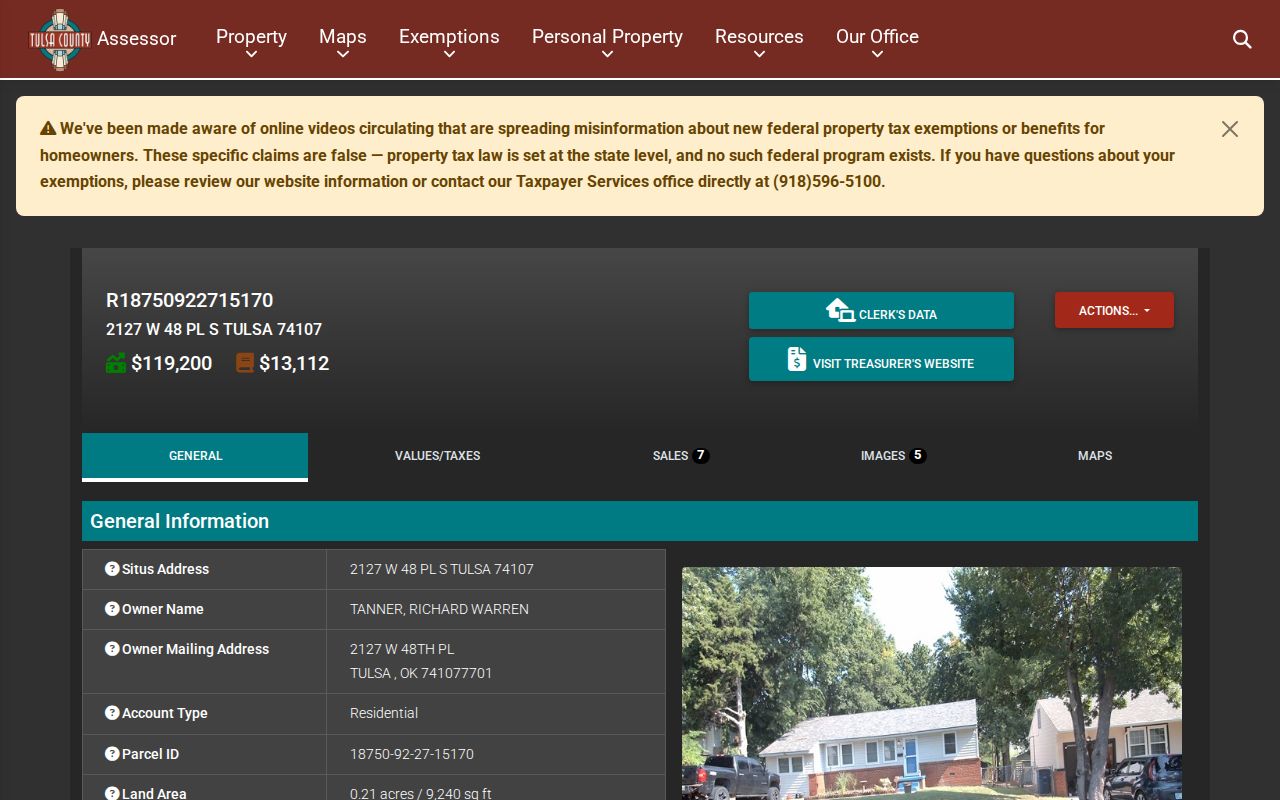
The distinction among situs, mailing, and legal fields is why a single property record should never be read as a list of everyone living at an address.
Tulsa County Court Names Need Confirmation
OSCN supplies Tulsa County District Court party-name searching. A result can show a case number, filing date, case style, and the role in which a party matched. Those are useful anchors, but the same name can belong to more than one person. Match the case information with a separate address, time period, or court file before drawing a conclusion. Sealed, juvenile, and expunged material is not public.
Tulsa Municipal Court is a separate city court for traffic, parking, misdemeanor criminal, and certain municipal code matters. Its Court Records route offers electronic open-records requests and a Records window for counter forms. District Court cases belong with the County Court Clerk and OSCN, not the County Clerk’s land-record division.
Note: A court index locates a case; it does not establish a current address, identity, or the complete contents of a protected file.
Tulsa County Voter Records Have Two Access Paths
The OK Voter Portal is built for an individual to verify registration with the name as registered and date of birth. It is not a public tool for browsing a street. For authorized election data, the State Election Board provides an Election Data Warehouse and records-request route. The research documents a separate eligibility rule for full voter-list access, and sensitive identifiers remain confidential.
Oklahoma’s voter list also changes through routine maintenance. A state address-confirmation cycle can place a voter in inactive status when a notice is not answered, without proving that the person no longer lives in Tulsa County. A nonmatch can likewise reflect a name format, birth-date mismatch, timing, or a protected record. Treat it as a reason to use another lawful custodian route, not a reason to work around privacy protections.
Tulsa County Vital Indexes Point to a Record
OK2Explore is Oklahoma’s free birth and death index. It can help establish that a record is on file, but an index hit is not an entitlement to a certified copy. Under 63 O.S. § 1-323, birth records open after 125 years and death records after 50 years. The index displays limited birth information after 20 years and death information after five years, while certified copies follow eligibility rules from the Oklahoma State Department of Health.
For an eligible order, use the Vital Records FAQ and application instructions. Tulsa will-call pickup is available after an eligible online or phone order. Marriage licenses come from county clerks and divorce decrees are court files, so neither should be represented as a statewide vital-index result.
Tulsa County Residents in Earlier Directories
The Central Library Research Center/Oklahoma Room holds Tulsa city directories dating back to 1909. Its access is appointment based, normally with 48 hours’ advance booking. The Hardesty Regional Library Genealogy Resource Center documents a separate on-site run for 1928 through 1932, 1939 through 1941, and 1948. TCCL also maintains a digitized City Directories collection, but the research did not establish every digitized year, so check the live collection before assuming an online volume exists.
City directories are dated commercial compilations that can list names, addresses, occupations, business listings, and advertisements. A household’s first or last appearance is a lead, not proof of a move or death. Compare the year before and after, then use a census, a deed, or a death notice to corroborate it. The Tulsa County city directory explains the collection shelves and entry-reading process in detail.
A Genealogy Resource Center view points to the library route for older Tulsa County resident research.
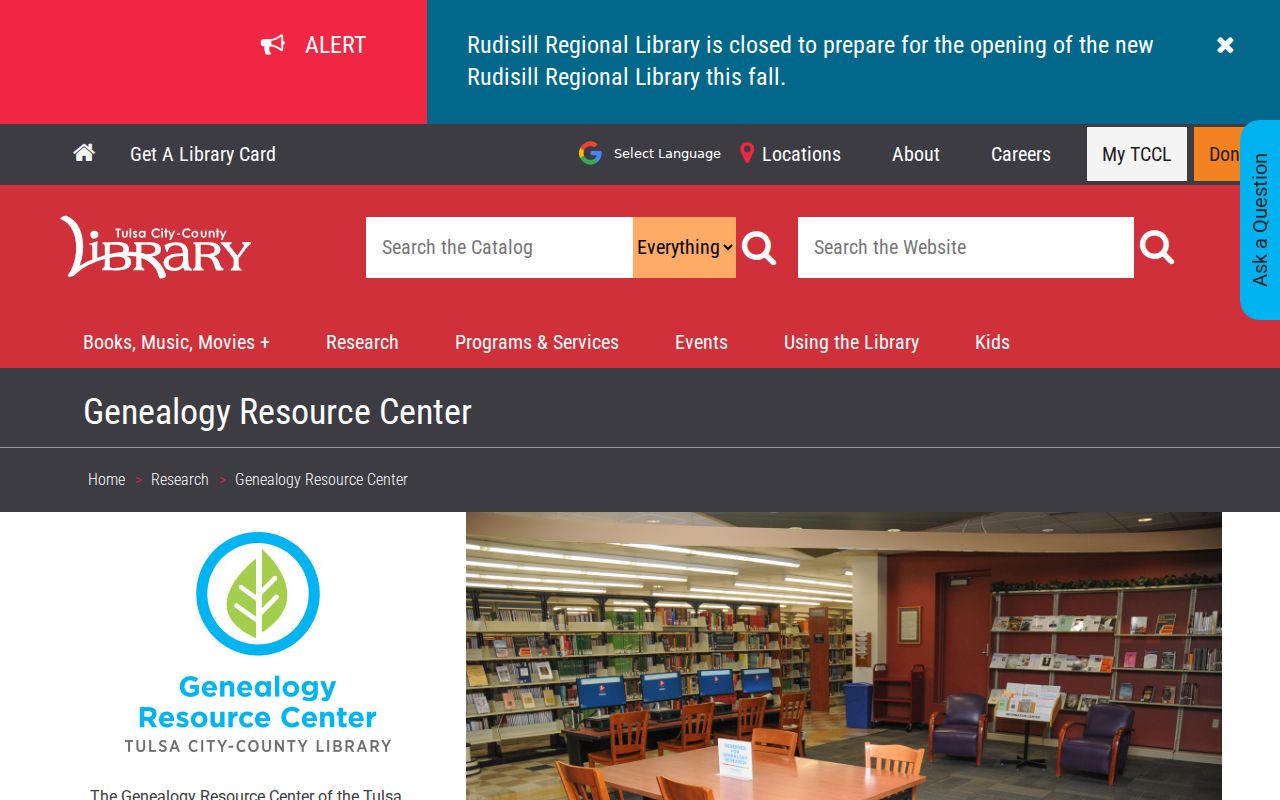
The library adds newspapers, maps, yearbooks, and microfilm to the record trail when a modern property or court index reaches its limit.
Tulsa County Geography Changes the Record Trail
Tulsa County includes Tulsa and parts of Broken Arrow, Bixby, Collinsville, Glenpool, Jenks, Owasso, Sand Springs, Skiatook, Sperry, and other postal communities. A county record may serve a broader area than a City of Tulsa record. The Assessor, County Clerk, Treasurer, District Court, and elections systems follow county-level functions, while a Tulsa permit or Municipal Court item depends on city jurisdiction. Confirm the physical address and the record keeper before requesting a file.
Postal geography is different again. City ZIP clusters are delivery geography, not city or county boundaries. A Tulsa mailing name or ZIP does not settle municipal jurisdiction, legal parcel location, or court venue. When an address is near a boundary, use the parcel’s situs and legal description, then ask the relevant office which system holds the record.
Tulsa County Requests Work Best When Focused
The Oklahoma Open Records Act, 51 O.S. §§ 24A.1–24A.31, calls for prompt, reasonable access while allowing an office to protect records and avoid undue disruption. Tulsa County provides an Open Records Act route and a county request form. Name the department, describe the record, give a date range, and include a known instrument number, case number, or parcel ID. Ask for inspection or a cost estimate before ordering a large set of copies.
Online access is only one channel. The Assessor accepts data or map requests at its counter, by phone, or through its data-request email. The County Clerk maintains historical camera and counter paths. City-held records may go through the City open-records gateway, where a written City Clerk form is available to people without internet access. A narrow request gives the custodian a meaningful search target.
The Assessor’s published policy supplies useful limits for a request. It describes ordinary copies at up to $0.25 a page, certified copies at $1 a page, and a separate data or map route when a visual search will not provide the needed item. The policy also says the County Clerk, not the Assessor, is the legal ownership repository. For City Clerk material, give a time frame or usable search terms rather than asking for an unlimited category. The City directs online requests to the appropriate portal but permits a written City Clerk form for a person without internet access. These alternatives matter when a search system is incomplete, unavailable, or too broad to answer the question.
Lawful personal use. Tulsa County records may support personal, family-history, civic, or property research. Do not use them to stalk, harass, intimidate, or assemble a resale list from protected or restricted data.
Tulsa County Protected Records Are Not Gaps
Some missing results are intentional. Oklahoma’s Address Confidentiality Program protects qualifying participants through a substitute address, and Election Board restricted-record programs protect eligible voter information. Juvenile, sealed, and expunged court material is not a public resident-search resource. Recorded documents may also redact protected data. A blank result can reflect privacy, a changed name, an older format, or a delayed update rather than the absence of a person.
Commercial people-search products are a separate category from official records. They may combine old data, make same-name errors, charge for access, and offer their own removal routes. They do not replace a custodian’s correction process. For an inaccurate government record, contact the office that maintains it; for a protected record, respect the protection. Note: Public inspection does not authorize harassment, data resale, or republishing a reconstructed list of households.